
Football History
From Vizekusen to Champions
How years of painful near misses created one of German football's most famous labels — and how Bayer 04 finally rewrote the story.
Leverkusen · Bayer 04
I
A Story About Almost
For years, Bayer 04 Leverkusen carried one of German football's most famous labels.
Vizekusen.
The word combined Leverkusen with the German term for runner-up. It captured a period in which Bayer 04 repeatedly came extraordinarily close to the biggest trophies without quite winning them.
It was memorable because the near misses were not isolated.
Leverkusen finished second in the Bundesliga again and again. Title races slipped away. Finals ended in defeat.
Eventually, finishing second stopped feeling like a result and became part of the story told about the club.
II
Getting Closer
Bayer 04 had already established itself as one of Germany's strongest teams during the 1990s.
The club won the DFB-Pokal in 1993 and increasingly challenged near the top of the Bundesliga.
But the league title remained out of reach.
In 1997, Bayer 04 finished second behind Bayern Munich.
Another runners-up finish followed in 1999.
Leverkusen was no longer simply trying to establish itself among the Bundesliga's strongest clubs.
It was getting close enough for second place to hurt.
III
Unterhaching, 2000
The 1999/2000 season brought Bayer 04 closer than ever before.
Going into the final matchday, Leverkusen led the Bundesliga and travelled to Unterhaching knowing that a draw would be enough to win the championship.
Instead, the afternoon began with disaster.
Michael Ballack's own goal gave Unterhaching the lead. Bayer 04 eventually lost 2–0.
Bayern Munich won their own match and finished level with Leverkusen on points, taking the championship on goal difference.
A season that had seemed destined to produce Bayer 04's first German championship ended with another second place.
IV
The Season That Changed Everything
Two years later, Bayer 04 produced one of the most remarkable seasons in German football history.
Klaus Toppmöller's team challenged for the Bundesliga, reached the DFB-Pokal final and advanced through the Champions League.
With three Bundesliga matches remaining, Leverkusen held a five-point advantage over Borussia Dortmund.
Then the season began to turn.
Defeats against Werder Bremen and Nürnberg allowed Dortmund to move ahead.
Bayer 04 won on the final day, but Dortmund did too.
Leverkusen finished second in the Bundesliga for the fourth time.
V
Three Competitions. Three Second Places.
The Bundesliga disappointment was only the beginning.
On 11 May 2002, Bayer 04 faced Schalke 04 in the DFB-Pokal final in Berlin.
Dimitar Berbatov gave Leverkusen the lead, but Schalke came back to win 4–2.
Four days later came an even bigger stage.
Bayer 04 faced Real Madrid in the Champions League final at Hampden Park in Glasgow.
Lúcio cancelled out Real's opening goal before Zinedine Zidane scored the decisive goal shortly before half-time.
Real Madrid won 2–1.
Within weeks, Bayer 04 had finished second in the Bundesliga, the DFB-Pokal and the Champions League.
VI
Vizekusen
After 2002, the pattern became almost impossible to separate from Bayer 04's public image.
Vizekusen became shorthand for a club that could build outstanding teams, challenge Germany's strongest sides and compete on Europe's biggest stage — but somehow fall just short.
The label simplified a much more complicated football story.
Reaching a Champions League final was itself an extraordinary achievement. Regularly competing near the top of the Bundesliga demonstrated consistency rather than failure.
But football narratives are rarely that generous.
Every subsequent title challenge could be measured against what had happened before.
In 2011, another second-place Bundesliga finish added one more chapter to the story.
VII
The Season That Broke The Story
More than two decades after 2002, Bayer 04 produced a season that changed the meaning of its football history.
Under Xabi Alonso, Leverkusen took control of the 2023/24 Bundesliga title race and refused to let go.
On 14 April 2024, Bayer 04 defeated Werder Bremen 5–0 at the BayArena.
With five Bundesliga matches still remaining, Leverkusen were German champions for the first time.
There was no final-day collapse. No goal-difference heartbreak. No second place.
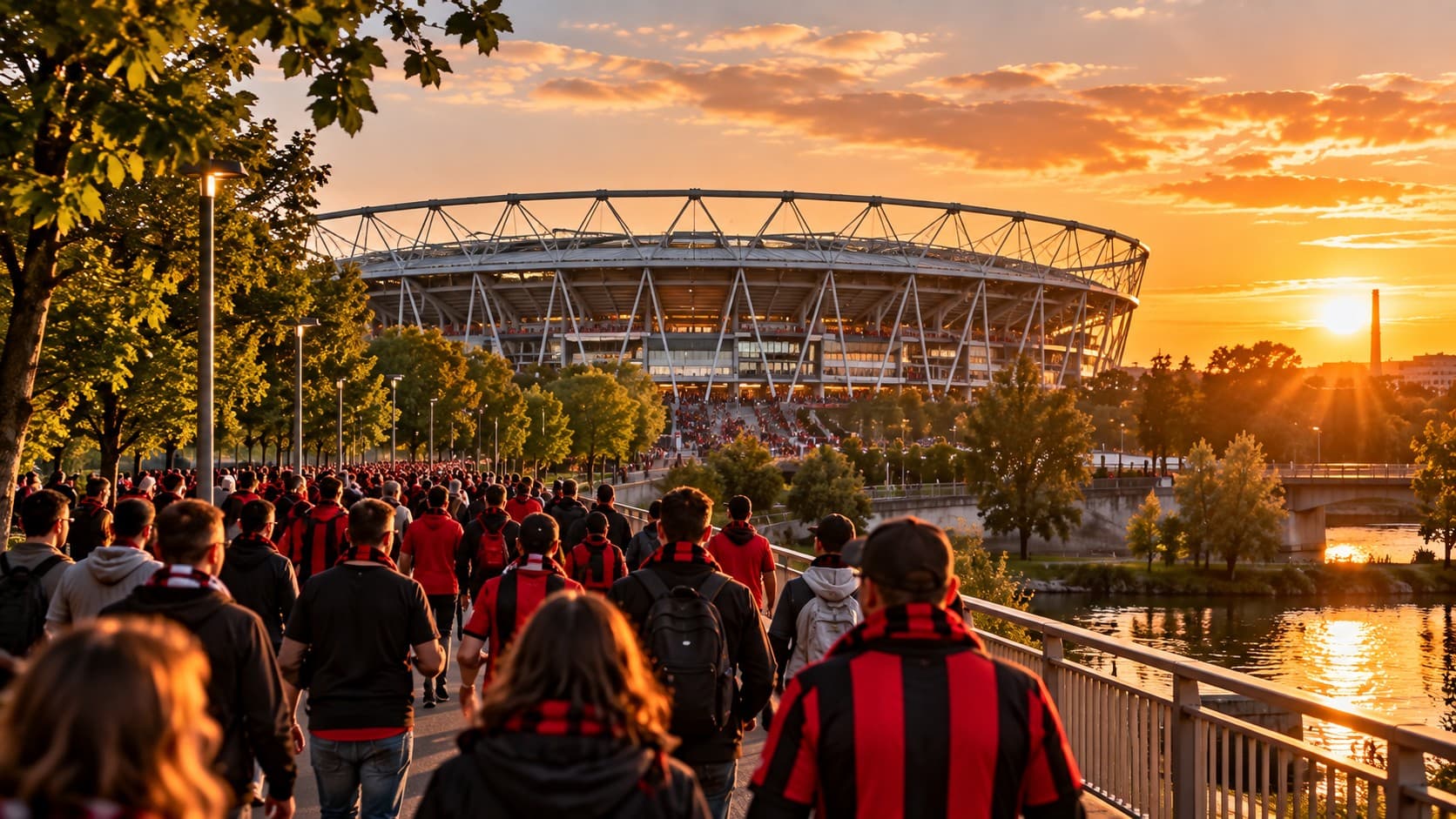
After decades of near misses, supporters entered the pitch and celebrated the title inside the stadium where so much of the old story had been written.
VIII
From Vizekusen To Invincibles
Winning the championship would already have rewritten Bayer 04's history.
The team went further.
Leverkusen completed all 34 Bundesliga matches without losing: 28 victories, six draws and zero defeats.
No Bundesliga team had ever completed an entire season unbeaten.
Bayer 04 also won the DFB-Pokal, completing a domestic double. The club's 51-match unbeaten run in all competitions ended only in the UEFA Europa League final against Atalanta.
The contrast with 2002 was extraordinary.
Then, one exceptional season had produced three second places. Twenty-two years later, another exceptional season produced the club's first Bundesliga title, an unbeaten league campaign and the DFB-Pokal.
Vizekusen remains part of Bayer 04's history. But it no longer defines how that history ends.

Continue Your Journey
Keep Exploring German Football.
Follow this story into its club, its football world and another chapter of German football culture.
Club World
Bayer 04 Leverkusen World
Football with Factory Roots
Explore Club →

City World
Leverkusen World
Discover a compact football city on the Rhine shaped by Bayer 04, industrial roots and more than a century of football history.
Explore World →
Another Club World
Eintracht Frankfurt World
Follow the Eagle
Explore Club →
Related Culture
From Factory Roots to Champions
How Bayer 04 grew from a factory sports club into one of German football's defining modern clubs while keeping its distinctive connection to Leverkusen.
Read Story →