

Football Culture
The Diamond of the North
Blue. White. Black. Four simple lines that have represented Hamburger SV for more than a century.
Hamburg · HSV
I
Four Lines
Football crests are usually crowded places. Initials, animals, crowns, dates, city symbols and references to history compete for space inside a small badge. Hamburger SV chose something different.
There are no letters in the HSV diamond. No "HSV". No "Hamburg". No year of foundation. Look at it without knowing German football and there is almost nothing to explain what it represents.
A blue background. A white square standing on its point. Black and white borders.
And yet in German football, almost nobody needs the explanation. The diamond is HSV.
II
Born in Hamburg
The story of the diamond begins with the creation of the modern Hamburger Sport-Verein in 1919. Three sporting traditions came together: Hamburger SV von 1888, SC Germania von 1887 and FC Falke 06. The new club needed an identity of its own.
Hamburg itself provided part of it. The football team would play in red and white, the colours of the city. But the club identity also carried blue, white and black from the traditions that had come together in the new HSV.
In August 1919, the new diamond appeared on the shirt for the first time. More than a century later, its basic form remains instantly recognisable.
That continuity is unusual. Football has changed almost beyond recognition since 1919. Stadiums have disappeared and been rebuilt. Competitions have been created. Shirts, sponsors and commercial identities have changed repeatedly.
The diamond survived.
III
A Maritime Symbol
For a club from Hamburg, the shape was not created in isolation from the city around it. The diamond has roots in the visual language of Hamburg's maritime world and is associated with the signal flag known in Germany as the Blauer Peter — the Blue Peter.
In maritime signalling, the flag indicated that a vessel was preparing to leave and that those belonging on board should return. For a city shaped by ships, trade and departure, it was a familiar piece of visual language.
Whether supporters standing in the Volkspark today think about maritime signalling is almost irrelevant. Over generations, the symbol acquired a meaning of its own.
It stopped being something inspired by Hamburg.
It became something that represented Hamburg.
IV
The Same Diamond
The great strength of a football symbol is that it can connect things that otherwise have very little in common. A supporter who remembers HSV becoming European champions in 1983 can wear the same diamond as a child experiencing the Volkspark for the first time.
The teams they know are different. The stadium is different. Their memories of HSV may have almost nothing in common. One remembers trophies and European nights. Another grew up with relegation battles and years in the second division.
The symbol between them is unchanged.
That is why the diamond appears far beyond the shirt worn by eleven players. It is on scarves, flags and jackets. It appears on stickers across Hamburg, on cars travelling towards away games and on old memorabilia kept long after the people represented in it have left the club.
Players represent HSV temporarily. The diamond does not.
V
More Than a Logo
Modern football is full of branding. Club identities are redesigned, simplified and adapted to digital screens. Logos become commercial assets designed to work everywhere from stadium walls to smartphone icons.
The HSV diamond somehow feels older than that language. Its simplicity was established long before anyone discussed brand recognition or digital design.
Yet that simplicity may be exactly why it has endured. You can draw it from memory. A child can recognise it. From the opposite end of a stadium, the shape is enough.
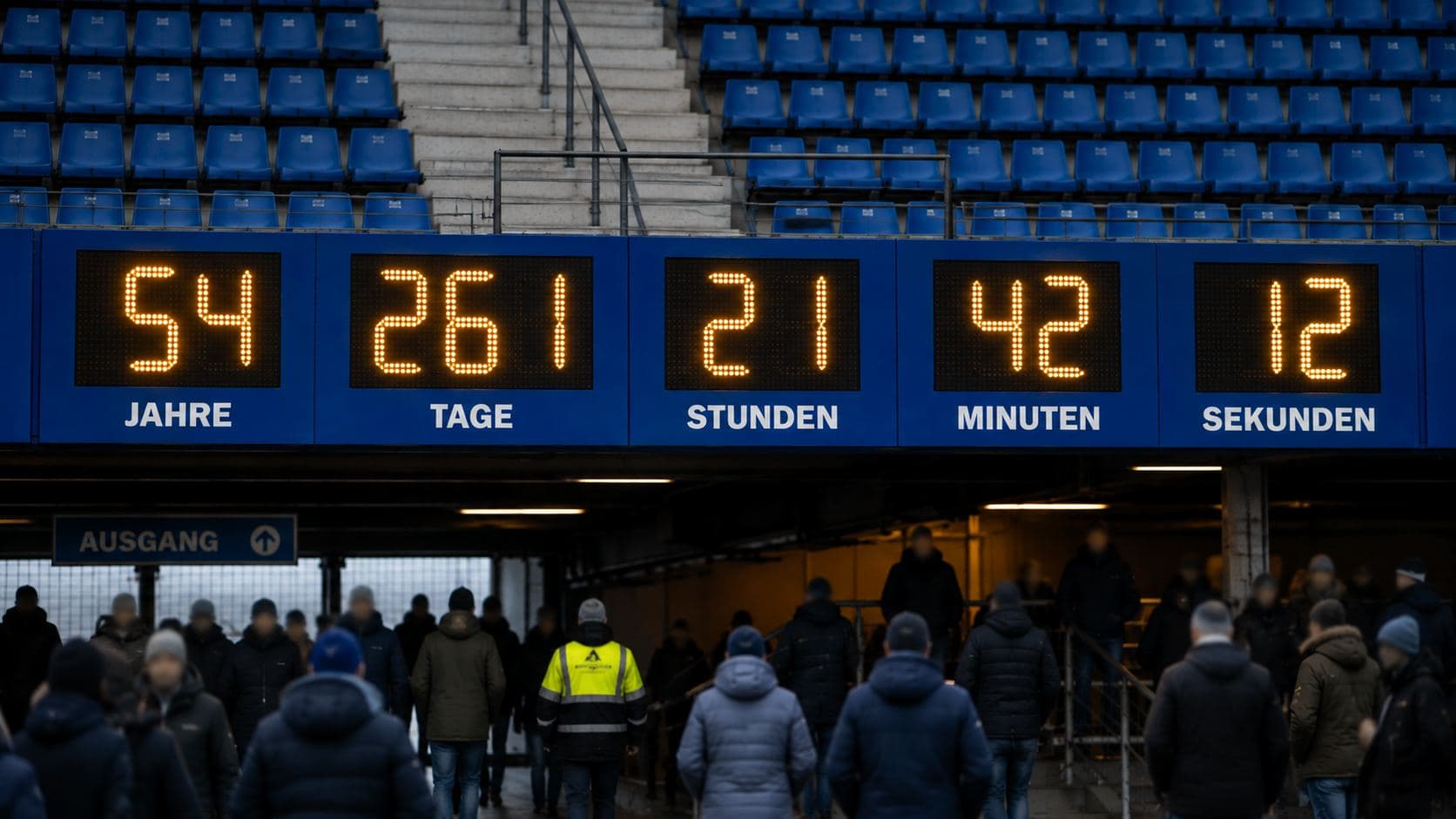
And when the club struggled, the distinction between club and symbol became even more important. Managers changed. Players changed. League status changed. Even the famous Bundesliga clock eventually disappeared from the Volkspark.
The diamond stayed where it had always been.

VI
The Diamond of the North
On matchday, you begin seeing it long before the stadium appears. On the S-Bahn. At stations. On scarves crossing streets in the west of Hamburg. Then increasingly often as thousands of people converge on the Volkspark.
Some carry decades of memories with it. Others are making their first. That is what allows a football identity to survive longer than any team or era.
The diamond does not tell you whether HSV won last weekend. It does not tell you which division the club plays in, who the coach is or whether the season is going well.
It tells you something simpler.
More than a century after it first appeared, four simple lines still say everything they need to say.
Continue Your Journey
Keep Exploring German Football.
Follow this story into its club, its football world and another chapter of German football culture.

Club World
HSV World
Northern Loyalty
Explore Club →
City World
Hamburg World
Experience one city, two completely different football worlds.
Explore World →

Another Club World
St. Pauli World
More Than a Football Club
Explore Club →

Related Culture
Northern Loyalty
Through good times and bad. A story about generations, belonging and loyalty in Hamburg.
Read Story →