
Matchday Culture
Cannstatt on Matchday
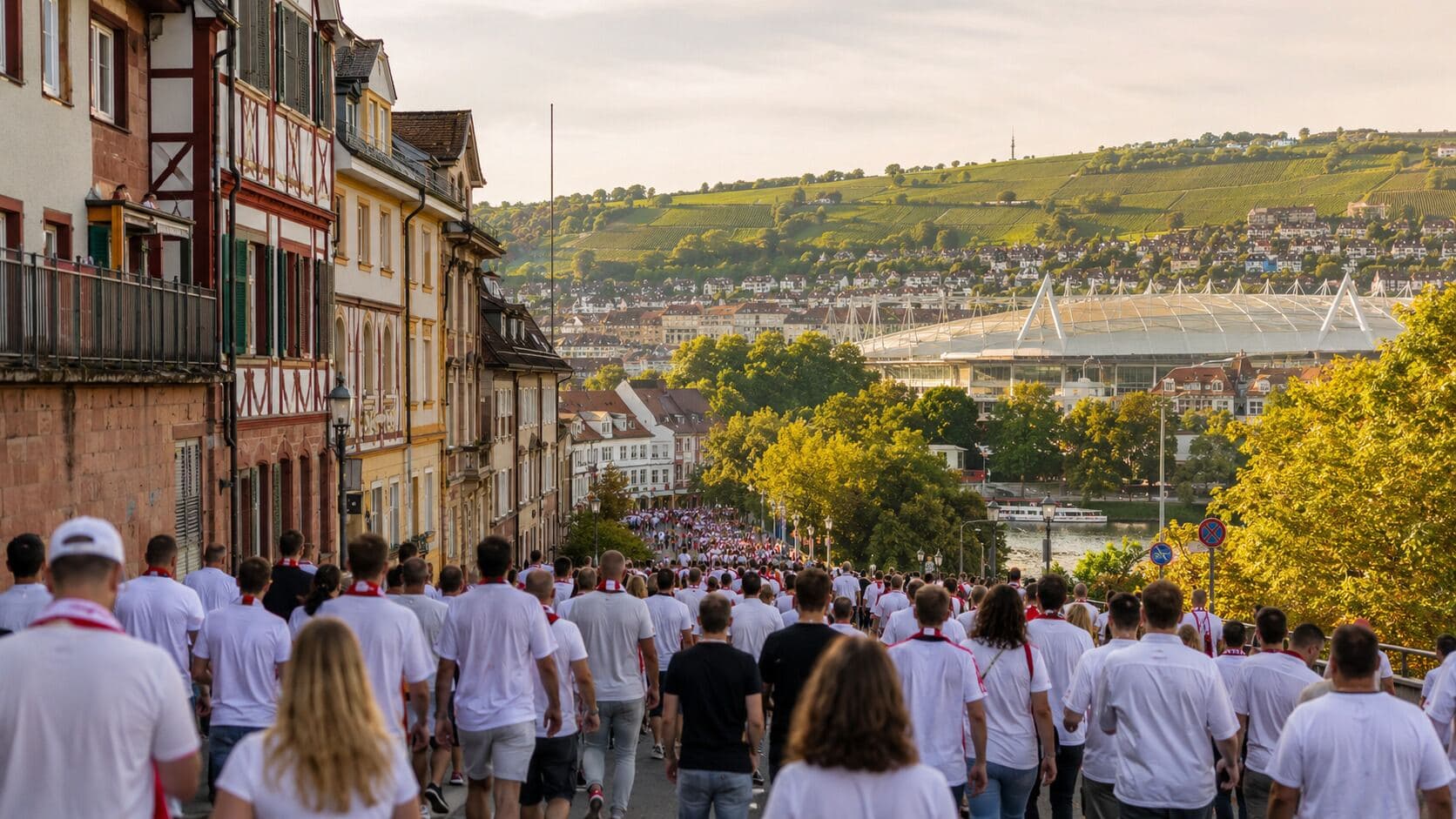
Follow the white-and-red crowd through Bad Cannstatt to the songs and flags beside the Neckar.
Stuttgart · VfB Stuttgart
I
Across Stuttgart
The VfB may carry the name of Stuttgart, but its matchday belongs especially to Bad Cannstatt.
Supporters travel towards the eastern side of the city from across Stuttgart and the wider region. White shirts with a red chest ring appear on S-Bahn platforms, Stadtbahn services and regional trains.
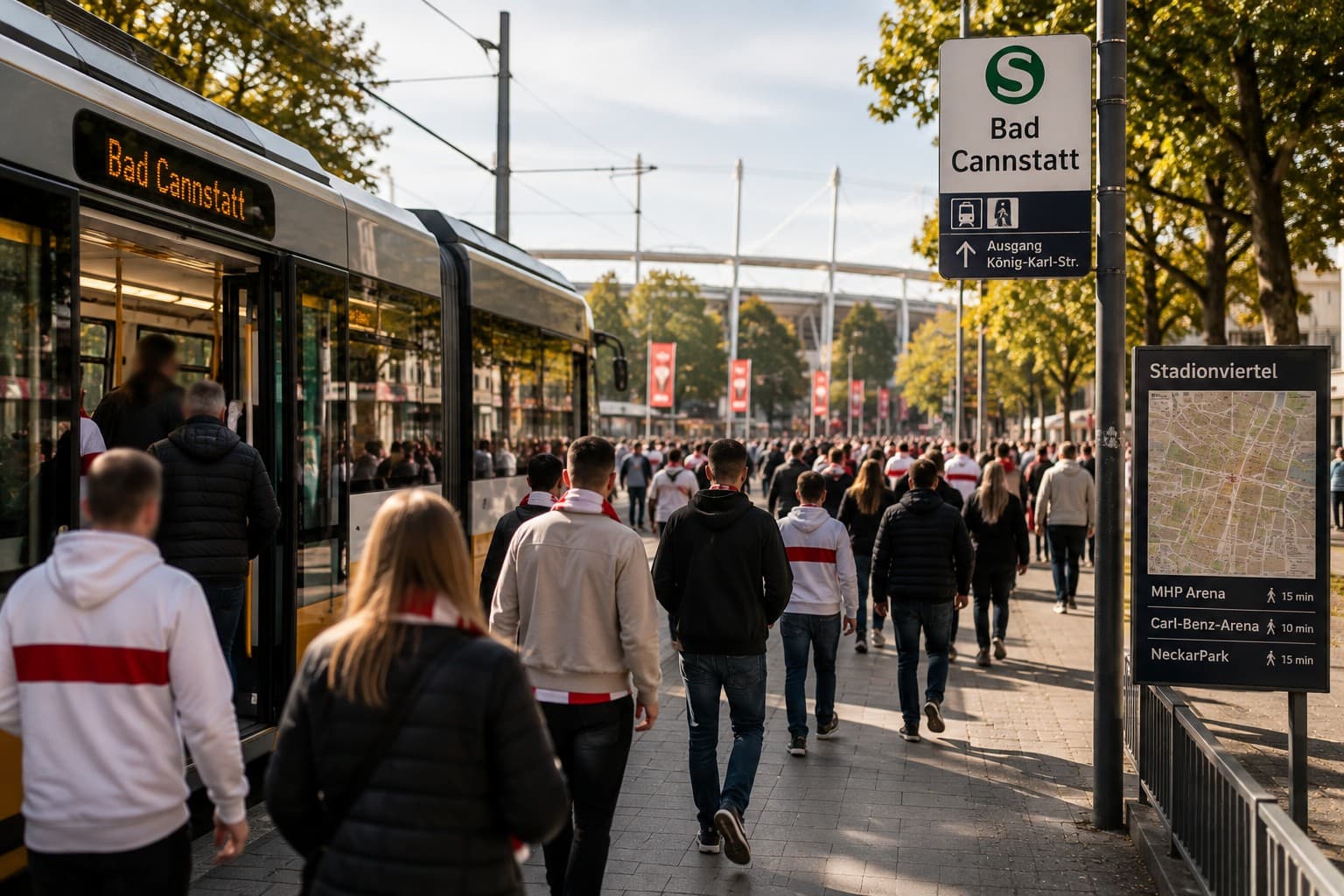
Some take the S1 directly to NeckarPark. Others arrive at Bad Cannstatt station and continue towards the stadium together.
The routes are different, but the colours make the destination obvious. The closer the crowd comes to the Neckar, the more ordinary city movement becomes a football procession.
II
The Walk to the Neckar
From Bad Cannstatt station, the final journey is made on foot.
Supporters move through the district and along the roads leading into NeckarPark. Groups from different parts of Württemberg join the same flow. Songs begin before the stadium is visible.
The walk explains something important about the VfB. Its support is not limited to the city boundary. Organised fan buses travel from Hohenlohe, Ostwürttemberg, Neckar-Alb and the area around Ulm.
The home match gathers a wider region in one place. Stuttgart is the name on the club. Württemberg supplies much of the crowd around it.
III
Between Football and the Wasen
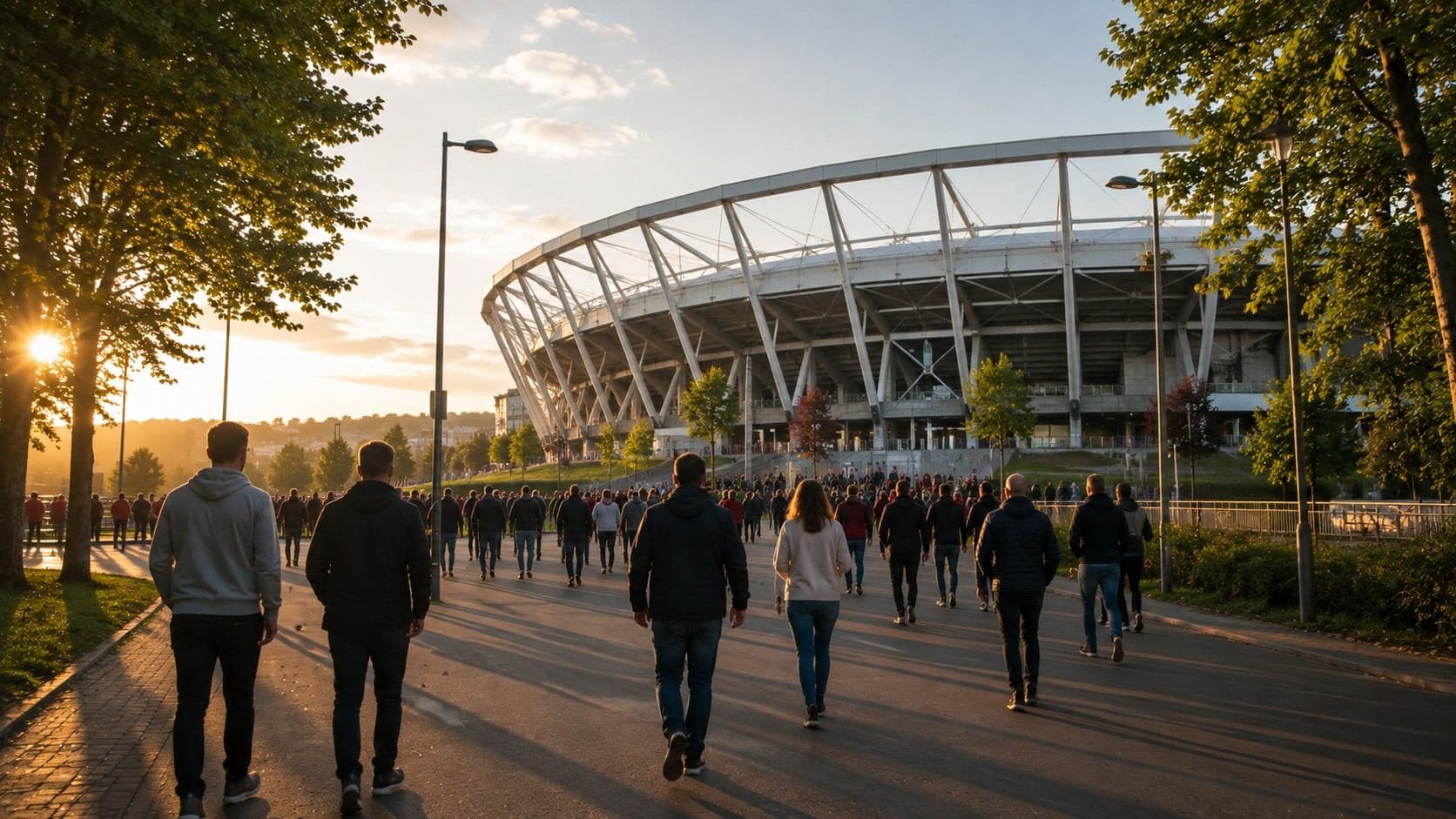
The stadium stands inside an area shaped by large crowds. The Porsche-Arena, Hanns-Martin-Schleyer-Halle and the Cannstatter Wasen all sit nearby.
For most of the season, the Wasen is an open event ground beside the football route. During the Stuttgart Spring Festival or Cannstatter Volksfest, the entire area changes.
Fairground rides, festival tents and thousands of additional visitors surround the journey to the stadium. Football and one of the region's largest public celebrations occupy the same part of the city.
The combination is vivid but requires planning. Trains become busier, parking disappears and the crowd around NeckarPark grows long before kick-off.
IV
The Brustring
Inside the stadium, one design connects almost every generation of VfB support.
The red chest ring runs across the club's white shirt. It is simple enough to recognise from the opposite side of the ground and distinctive enough to represent Stuttgart without explanation.
Across the stands, older shirts place different periods of club history beside one another. The sponsors, collars and materials change. The Brustring remains.
On a full matchday, thousands of individual rings become horizontal lines of red across the stadium.
The visual identity does not need a complicated symbol. One stripe is enough.
V
The Cannstatter Kurve
The emotional centre of the home support stands behind the goal in the Cannstatter Kurve.
Its blocks form an active support area. Standing supporters, large flags and continuous movement are part of the experience. The best view is not always an unobstructed one.
This is where songs are organised and where many of the stadium's choreographies begin. Messages and images can stretch across the stand before disappearing as quickly as they arrived.
The Kurve also acts beyond the match itself. Organised supporters participate in social projects, charitable activities and campaigns connected to the wider VfB community.
It is not merely the loudest area of the stadium. It is one of the places where the relationship between club and supporters is continually negotiated and expressed.
VI
Stuttgart Kommt
As kick-off approaches, the separate parts of the journey come together.
The teams finish their warm-up. Flags continue to move above the Cannstatter Kurve. The stadium turns towards the VfB anthem “Stuttgart kommt”.
Around 60,000 voices can carry the song through the arena. The title feels appropriate for a club whose supporters have spent the afternoon arriving from across an entire region.
Stuttgart has come by S-Bahn, Stadtbahn, regional train and fan bus. It has walked from Bad Cannstatt and gathered beside the Neckar.
Then the music ends, the Kurve takes over and Cannstatt becomes a football ground.
Continue Your Journey
Keep Exploring German Football.
Follow this story into its club, its football world and another chapter of German football culture.
Club World
VfB Stuttgart World
Measured by Our Own Standards
Explore Club →
City World
Stuttgart World
Discover football in southern Germany.
Explore World →
Another Club World
Eintracht Frankfurt World
Follow the Eagle
Explore Club →
Related Culture
Diva vom Neckar
Champions, relegation candidates and unexpected contenders — VfB Stuttgart has rarely followed a predictable path.
Read Story →